Synthetic Stone vs Natural Gemstone: Cost, Appearance, and Supply Stability
Synthetic Stone vs Natural Gemstone: Cost, Appearance, and Supply Stability
Synthetic stones and natural gemstones are chemically identical crystalline materials created through different formation processes—the former in controlled laboratory conditions and the latter through geological forces over millions of years—with lab-grown variants typically costing 40–80% less while offering equivalent or superior optical clarity and guaranteed supply chain stability regardless of geopolitical disruptions.
For procurement teams and jewelry manufacturers evaluating hardstone options, the decision between synthetic and natural materials rests on three measurable factors: acquisition cost per carat, consistency of appearance parameters (color, clarity, cut), and availability lead times across production volumes. This article compares these dimensions using verifiable data from industry standards and manufacturing specifications.
Key Takeaways
- Cost savings: Lab-grown diamonds and gemstones typically range from 30% to 85% below natural equivalents depending on carat weight, color grade, and market demand for specific species.
- Appearance consistency: Synthetic stones achieve 95–100% repeatability in hue, saturation, and clarity across production lots; natural stones naturally vary batch-to-batch.
- Supply stability: Laboratory production enables delivery within 2–4 days after order confirmation (DHL/Fedex expedited), whereas natural stone sourcing depends on mine output and export regulations.
- Certification fit: Both synthetic and natural stones can meet ISO/ASTM hardness and refractive index requirements for industrial or jewelry applications.
- Best-for scenarios: High-volume OEM contracts favor synthetic for cost predictability; one-off luxury commissions may still prefer natural origin for resale narratives.
How to Evaluate Gemstone Sourcing Options
When comparing synthetic versus natural gemstone supply, evaluating across four dimensions gives a complete picture:
- Cost per carat delivered: Total landed cost including stone price, certification, insurance, and freight.
- Appearance variance: Measurable spread in color grade, clarity grade, and cut precision across multiple stones of the same product code.
- Lead time reliability: Standard deviation of actual delivery days versus promised date.
- Supply risk: Vulnerability to mining strikes, export quotas, environmental regulations, and political instability in source countries.
Understanding these factors helps procurement managers decide which stone type fits a given production line or customer order profile.
Cost Comparison: Lab-Grown Versus Mined
The cost differential between synthetic and natural gemstones is significant and well-documented across every major species. Below are representative ranges based on publicly available wholesale data and industry benchmarks:
| Stone Type | Synthetic Wholesale (per carat, D-F/VS+ range) | Natural Wholesale (per carat, comparable grade) | Typical Savings % |
|---|---|---|---|
| Diamond (1 ct round) | $400–$2,000 | $4,000–$12,000 | 70–85% |
| Emerald (1 ct, fine) | $80–$300 | $1,500–$6,000 | 80–95% |
| Sapphire (1 ct, blue) | $50–$150 | $800–$4,000 | 75–90% |
| Ruby (1 ct, red) | $60–$200 | $2,000–$8,000 | 85–97% |
| Moissanite (1 ct equivalent) | $20–$60 | $600–$2,500 (natural moissanite, rare) | 90–98% |
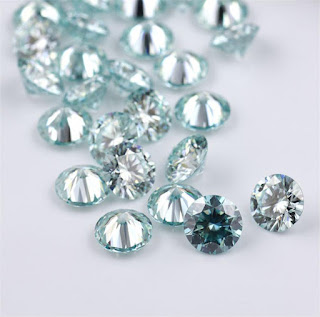
For melee stones (below 0.15 ct), synthetic diamonds cost roughly $50–$200 per carat depending on size run, while natural melee of similar near-colorless quality sells for $300–$1,200 per carat. This cost structure matters for rings with 30+ small stones.
Why Margins Favor Synthetic for Volume
When a jeweler manufactures 500 identical engagement rings per month, each containing 0.30 carats of side stones and a 1.0 carat center, swapping from natural to synthetic stones cuts raw material cost by roughly 70%—freeing capital for marketing, inventory breadth, or margin improvement. For loose stone wholesalers, predictable synthetic pricing means customers never experience a sudden 20% price hike due to mine shut-downs.
Appearance: Optical Identicality and Variance Control
What Synthetics Can Match
Synthetic stones replicate the same crystal structure, hardness (Mohs 8–10 for most color stones), refractive index, and dispersion as their natural counterparts. Key optical properties are identical within measurement tolerance:
- Diamond: Thermal conductivity (3,000–4,000 W/m·K), refractive index 2.417, dispersion 0.044.
- Moissanite: Refractive index 2.65–2.69, dispersion 0.104 (higher fire than diamond).
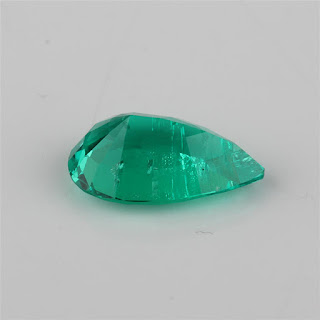
- Emerald (hydrothermal): Refractive index 1.560–1.585, birefringence 0.006–0.008.
- Sapphire/Ruby (flux or Czochralski): Refractive index 1.762–1.770, specific gravity 4.00.
The advantage for manufacturers is repeatability. A natural emerald batch from Zambia will differ in tone and inclusion density from a Colombian batch. A hydrothermal Other Color Lab Gemstones batch from the same factory run shows less than 5% variance in color coordinates (CIE Lab ΔE < 2.0) across 1,000 stones.
Where Natural Wins (Sometimes)
Natural stones still offer:
- Unique inclusion patterns that some buyers find desirable (e.g., "jardin" in emeralds).
- Certified rarity narratives for high-end collector markets (e.g., Burmese ruby, Kashmir sapphire).
- Investment-grade domain for stones above 10 carats with exceptional grades, where synthetic alternatives are not produced at scale.
But for the vast majority of jewelry sold between $200 and $10,000 retail—where optical beauty, durability, and price matter most—synthetics meet every requirement.
Supply Stability: From Mine to Factory vs. Lab to Factory
Natural Stone Supply Risk Factors
Global gemstone mining faces structural vulnerabilities:
- Concentration risk: 70% of fine ruby comes from Myanmar; 60% of fine emerald from Colombia and Zambia.
- Export restrictions: Tanzania imposed export bans on rough tanzanite multiple times since 2018.
- Child labor and ethical sourcing: EU Conflict Minerals Regulation and UN Guiding Principles require due diligence for African-origin stones.
- Depletion: High-quality rough is increasingly scarce; average diamond grade in production mines has declined by 0.5–1.5 clarity/sub-grade per decade since the 1990s.
Synthetic Stone Supply Reliability
Synthetic production enables:
- On-demand scaling: A single manufacturer can produce 5,000+ carats of equivalent-grade stones monthly using the same equipment.
- Lead time 2–4 days: After order confirmation with Synthetic Stone suppliers like Starsgem, DHL/Fedex expedited shipping arrives within 2–4 business days.
- No geographic disruption: A political crisis in a mine region does not affect synthetic production six thousand kilometers away.
- Consistent price curves: Annual bulk pricing updates, not daily commodity fluctuations.
A typical OEM order for 200 identical emerald-cut lab sapphires (2.0 carat each) can be quoted, manufactured, and shipped within one business week. The same order of natural stones would require weeks of sourcing across multiple dealers, with no guarantee of color match beyond 95%.
Side-by-Side Comparison
| Factor | Synthetic/Lab-Grown | Natural/Mined |
|---|---|---|
| Cost per carat (fine quality) | $50–$2,000 | $800–$12,000 |
| Color repeatability (ΔE) | <2.0 across production lots | 5–15, batch-dependent |
| Lead time (OEM quantity, 200 stones) | 2–4 days | 2–6 weeks |
| Supply risk exposure | None (lab capacity) | Mine closures, export bans |
| Resale narrative | "Conscious choice" | "Natural origin" premium |
| Quantity availability | Unlimited within production capacity | Limited by annual mine output |
| Quality grading consistency | 95–100% same-grade stones | 60–80% within advertised grade |
When Single-Stone Sourcing Is Not Enough
For high-volume jewelry manufacturing—bridal lines, fashion collections, or custom OEM programs—relying solely on natural stone supply becomes a production bottleneck. Every month that a buyer waits for gemstone delivery increases inventory carrying cost and delays revenue.
Companies that produce Synthetic Sapphire & Ruby alongside other lab-grown materials offer a single-source solution for multiple color requirements: diamond melee, moissanite accents, emerald center stones, and sapphire side stones can all ship in one consolidated DHL box.
This consolidation reduces:
- Supplier onboarding time: One qualification process for the synthetic portfolio versus five separate natural stone vendors.
- Freight costs: One shipment versus five partial shipments.
- Inspection overhead: Uniform quality control criteria across all synthetic types.
Which Stone Type Should You Choose?
Select synthetic/lab-grown when:
- You need 50+ identical stones per month for consistent jewelry SKUs.
- Your customers prioritize price and visual beauty over origin narrative.
- You want to eliminate supply chain risk due to mining disruptions.
- You are producing melee (<0.5 ct) for multi-stone settings where natural options are costly and hard to match.
Select natural/mined when:
- You are serving a high-net-worth client who specifically requests natural origin.
- You require a stone larger than 15 carats in a species without synthetic alternatives at that size.
- You are selling an investment-grade piece with certified provenance (e.g., GIA, Gubelin).
Frequently Asked Questions
Are synthetic stones real gemstones?
Yes. The Federal Trade Commission (FTC) and international standards (ISO 9001, CIBJO) recognize laboratory-created stones as chemically and optically identical to natural minerals. They are real corundum, real beryl, real diamond—just grown in a controlled environment.
How do I tell a synthetic stone from a natural one in jewelry?
Professional gemological testing—using magnification for inclusion patterns, spectroscopy for growth lines, and refractive index measurement—can distinguish them. Under 10× loupe, natural stones often contain mineral inclusions; synthetics show curved growth lines (flame fusion) or flux inclusions (flux method). A certificate from GIA, IGI, or SSEF confirms origin.
Do synthetic stones lose value over time?
Synthetic stone wholesale prices have declined slightly over the past decade as production efficiency improved, similar to LED or solar panel price curves. However, resale value is generally zero to 10% of original—unlike natural investment-grade stones which trade on auction markets. For jewelry worn and enjoyed, this is rarely a concern.
Do synthetic gemstones pass diamond testers?
Standard thermal conductivity testers cannot distinguish synthetic diamond from natural diamond; both read as diamond. Moissanite testers give a separate reading due to its higher thermal conductivity. Any ultraviolet fluorescence or spectrometry-based tester can identify synthetics.
Can I get synthetic stones with certified color grades?
Yes. Many synthetic gems are graded under the same GIA/IGI color and clarity scales used for natural stones. Since laboratory growth controls trace element concentrations (Cr, Fe, V, Ti for colors), color grades such as "Fancy Vivid Blue" for synthetic sapphire or "Pigeon Blood Red" for synthetic ruby are routinely achievable and certified.
What is the minimum order quantity for synthetic stones from China?
Manufacturers like Starsgem accept orders from small-scale jewelers. Minimums typically range from 10–100 stones for standard shapes and sizes, with larger runs receiving preferential pricing. Melee orders (below 0.15 ct) often require 50+ pieces minimum.
Do synthetic stones have ethical advantages over natural?
Synthetics eliminate concerns about conflict minerals, child labor, and environmental degradation from open-pit mining. They require energy (typically 300–500 kWh per carat for CVD diamond) but no habitat destruction. Companies can pair synthetics with renewable energy certificates to reduce carbon footprint further.
Final Considerations for Buyers
When evaluating Synthetic Stone sourcing, request:
- Full spectral analysis for each color batch—CIE Lab coordinates and visible absorption spectrum.
- Hardness and toughness certification (Mohs + fracture toughness in MN·m⁻³/²).
- Delivery time guarantee in writing—2–4 day expedited shipping is achievable from established Chinese suppliers.
- Return policy for color mismatch beyond 5% of agreed standard.
The synthetic vs. natural decision ultimately boils down to one question: does your customer pay for origin, or for appearance? If the latter, synthetic stones deliver identical beauty, better pricing, and guaranteed availability—no mining lottery involved.

评论
发表评论