How to Compare DEF, GHI, and Fancy Color Moissanite Stones
How to Compare DEF, GHI, and Fancy Color Moissanite Stones
Comparing DEF, GHI, and fancy color moissanite stones comes down to three measurable factors: color grading under standard lighting, the stone's refractive index and cut precision, and your specific jewelry application—where colorless stones mimic diamonds while fancy colors deliver a deliberate statement.
Introduction
Most buyers comparing DEF, GHI, and fancy color moissanite stones assume that "whiter is better." That assumption costs them money. DEF moissanite sits at the top of the color scale, but GHI stones are nearly indistinguishable to the naked eye once set in a ring—and they cost less per carat. Fancy colors, meanwhile, are a completely different category: they are not trying to imitate diamond at all.
This guide walks you through a practical comparison framework. You will learn how color grades are defined, how to evaluate a stone in person, which grades suit which jewelry styles, and how to buy without overpaying. The focus is on moissanite supplied by B2B manufacturers like Starsgem, a lab-grown diamond, moissanite, and hydrothermal emerald manufacturer serving jewelry brands and OEM buyers.
Key Takeaways
- DEF moissanite shows no visible warmth; GHI shows a faint yellow only in large sizes or side-by-side tests.
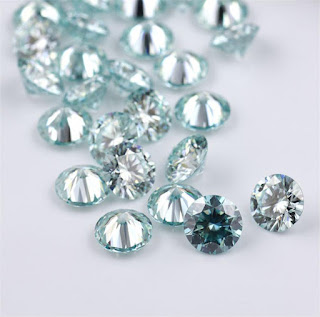
- Fancy color moissanite is graded by hue, tone, and saturation—not by the D-to-Z scale.
- Cut quality affects color perception more than the color grade itself.
- Larger stones (above 1 carat equivalent) reveal color differences that small melee does not.
- Buying from a manufacturer directly lets you request specific color lots and certificates.
What You Need Before Starting
Before you compare stones, gather a few tools and reference points. You need a standard jeweler's loupe (10x magnification), a white background card, and a daylight-equivalent light source rated at 5000–6500K. Industry color grading for moissanite follows the same D-to-Z scale used for diamonds, defined by the Gemological Institute of America (GIA), though moissanite is not GIA-graded as a diamond.
You also need to understand your end product. A solitaire engagement ring demands a different color grade than a halo pendant or a pair of stud earrings. If you are sourcing for a jewelry line, review the Product Categories available from your supplier so you match stone grade to mounting style.
Finally, set a budget per carat equivalent. DEF rounds typically command a premium over GHI. Fancy colors vary wildly depending on rarity of hue—blue and green cost more than yellow or grey.
Step 1 — Understand the Color Scale for Moissanite
What to Do
- Learn the D-to-Z scale: D, E, F are colorless; G, H, I are near-colorless; J and below show visible warmth.
- Recognize that moissanite is inherently slightly yellow-green in its rough form; manufacturers adjust growth conditions to produce whiter stones.
- Request a grading report or certificate from your supplier that states the color grade for each lot.
Why This Matters
Moissanite's color behavior differs from diamond. Because moissanite has a refractive index of 2.65–2.69—higher than diamond's 2.42—it disperses light more intensely. That fire can mask body color in smaller stones. A 0.5-carat GHI moissanite may look perfectly colorless in a bright setting, while a 2-carat stone shows a faint yellow tint along the girdle.
Common Mistakes to Avoid
- Judging color under warm LED lighting: Warm light (2700–3000K) masks yellow. Always evaluate under daylight-equivalent 5000–6500K.
- Ignoring the culet and pavilion depth: A deep pavilion traps light and can make a colorless stone look dark, not yellow. Check proportions first.
Step 2 — Compare DEF vs. GHI in Real Settings
What to Do
- Place DEF and GHI stones side by side, table-up, on a white card.
- View them from the crown angle, then tilt to inspect the girdle and pavilion.
- Repeat the test in a mounted setting—prong, bezel, and halo mountings change how much body color you see.
- Ask your supplier for stones from the same cutting batch to isolate color as the only variable.
Why This Matters
The price gap between DEF and GHI is real but often unjustified for certain products. Industry practice shows that GHI stones set in yellow gold or rose gold look identical to DEF because the metal reflects warmth into the stone. In white gold or platinum, the difference is more noticeable—but only to trained eyes or in stones above 1.5 carats.
For an Emerald Cut moissanite, color grading matters more than for brilliant cuts. Emerald cuts have large open tables and step facets. They show body color clearly. If you are sourcing emerald-cut stones for a vintage-style ring, GHI may look disappointingly yellow. DEF is the safer call for this shape.
Common Mistakes to Avoid
- Buying all-DEF for melee: Stones under 0.15 carat do not show color differences to the naked eye. GHI melee saves you 10–20% with zero visible compromise.
- Assuming GHI is "lower quality": GHI is not a defect grade. It is a near-colorless grade that performs excellently in most mountings.
Step 3 — Evaluate Fancy Color Moissanite Separately
What to Do
- Understand that fancy colors use a different grading language: hue (the dominant color), tone (lightness to darkness), and saturation (intensity).
- Identify the hue family: yellow, green, blue, pink, grey, and champagne are the most common moissanite colors.
- Check for uniformity—fancy color moissanite should show even color distribution, not zoning or patchiness.
- Request a video under both natural and indoor lighting before committing to a bulk order.
Why This Matters
Fancy color moissanite is not trying to imitate diamond. It is a category of its own, often used for fashion jewelry, statement pieces, and colored-stone accents. The most popular fancy colors in the market are champagne (light brown-yellow), green, and blue. These stones are produced by adding trace elements during crystal growth, and the color is stable—it will not fade in sunlight or under normal wear.
If you are building a colored-stone line, browse the Color Diamond range to see which hues your supplier can consistently deliver. Consistency matters: a 100-piece order of green moissanite must match across the batch, not just within one sample.
Common Mistakes to Avoid
- Applying the D-to-Z scale to fancy colors: A "G" fancy color means nothing. You must specify hue, tone, and saturation.
- Ignoring the metal pairing: Fancy yellow moissanite looks muddy in yellow gold but striking in white gold. Blue moissanite pairs well with both white and rose gold.
Step 4 — Assess Cut Quality and Its Effect on Color
What to Do
- Examine the stone's symmetry and polish under 10x magnification.
- Check the table percentage (ideal range for round brilliant moissanite is 53–58%) and crown angle (34–35 degrees).
- Look for windowing or extinction—areas where light passes through without reflecting back.
- Compare the same color grade across two different cut qualities to see how cut affects perceived whiteness.
Why This Matters
A well-cut moissanite returns more light to the eye, which makes the stone look whiter and brighter. A poorly cut stone—even in DEF—can look dull or dark. The industry standard for moissanite cutting follows the same proportion guidelines as diamonds, but moissanite's higher refractive index means slight deviations are more forgiving.
For fancy colors, cut quality determines how saturated the color appears. A shallow cut washes out color; a deep cut makes it look dark and muddy. The sweet spot for colored moissanite is a slightly shallower pavilion than colorless stones, which allows more light to pass through the body and show the hue.
Common Mistakes to Avoid
- Prioritizing color over cut: A GHI stone with excellent cut will outperform a DEF stone with poor cut in every visual metric.
- Skipping the loupe check: Symmetry defects like misaligned facets or off-center culet reduce brilliance and make color look uneven.
Step 5 — Match Color Grade to Your Jewelry Application
What to Do
- For solitaire engagement rings in white gold or platinum: choose DEF or E color.
- For halo settings, three-stone rings, or side-stone designs: GHI is sufficient because surrounding stones mask body color.
- For yellow gold or rose gold mountings: GHI or even IJ works well; the metal's warmth neutralizes any yellow tint.
- For fashion jewelry and statement pieces: use fancy colors to create contrast and visual interest.
- For melee under 0.15 carat: any grade above J is visually identical; buy GHI to control costs.
Why This Matters
Matching color grade to application is the single biggest cost-saving decision you can make. A jewelry brand that defaults to DEF for every product is leaving margin on the table. The table below summarizes the recommended grade by application:
| Application | Recommended Grade | Why |
|---|---|---|
| Solitaire ring, white metal | DEF | Max brightness, no warmth visible |
| Halo or three-stone ring | GHI | Surrounding stones mask body color |
| Yellow/rose gold mounting | GHI or IJ | Metal warmth neutralizes yellow |
| Emerald cut, any mounting | DEF | Step facets show color clearly |
| Melee under 0.15 ct | GHI | Size hides color differences |
| Fashion statement piece | Fancy color | Deliberate hue, not diamond imitation |
Common Mistakes to Avoid
- Using DEF for everything: You pay a premium for a difference no one sees in yellow gold or small sizes.
- Using GHI for emerald cuts: The open table of step cuts exposes body color; GHI emerald cuts can look disappointingly yellow.
Step 6 — Verify Supplier Consistency and Certificates
What to Do
- Ask your supplier for the color grading method they use—visual comparison to master stones or spectrometer measurement.
- Request a certificate for each lot, not just one sample stone.
- Order a pre-production sample batch of 5–10 stones before committing to a large order.
- Confirm the return policy for color mismatches.
Why This Matters
Moissanite color grading is less standardized than diamond grading. Different manufacturers may label the same stone differently. A reputable B2B manufacturer will grade conservatively and stand behind their labels. Starsgem, for example, offers registration without obligation and provides service and advice on stone selection. Delivery time is typically 2–4 days with expedited shipping via DHL or FedEx, which makes sample verification fast.
Industry data suggests that moissanite color consistency within a single production batch is generally good, but batch-to-batch variation can occur. That is why a pre-production sample is non-negotiable for serious buyers.
Common Mistakes to Avoid
- Trusting a single certificate: Certificates cover one stone, not your entire order. Ask for lot-level grading.
- Skipping the sample order: A 5-stone sample costs little compared to a 500-stone mistake.
Pro Tips for Success
- Buy GHI for anything under 1 carat equivalent unless the stone is an emerald cut or another step-cut shape.
- Always evaluate color against a white background, never against your hand or a dark counter.
- Request stones from the same growth batch when you need color consistency across a large order.
- For fancy colors, ask for a video under natural daylight—indoor lighting flatters saturated hues and hides unevenness.
- If you are unsure between DEF and GHI, order both in the same shape and size, then compare in your actual mounting.
Frequently Asked Questions
Is GHI moissanite visibly yellow?
In stones under 1 carat equivalent, GHI moissanite shows no visible yellow to the naked eye. In larger stones or step cuts like emerald and asscher, a faint warmth may appear. Under 5000–6500K lighting, most buyers cannot distinguish GHI from DEF without side-by-side comparison.
Do fancy color moissanite stones fade over time?
No. Fancy color moissanite gets its color from trace elements incorporated during crystal growth. The color is stable and will not fade under sunlight, UV exposure, or normal wear. This is a key advantage over some treated gemstones.
Which color grade is best for an emerald cut moissanite?
DEF is the safest choice for emerald cut moissanite. The large open table and step facets show body color more clearly than brilliant cuts. GHI emerald cuts can look visibly warm, especially in sizes above 1 carat equivalent.
How much more does DEF cost than GHI?
DEF typically commands a 10–20% premium over GHI from most manufacturers. The exact difference depends on size, shape, and supplier. For melee under 0.15 carat, the price difference is minimal, but the visual difference is also zero.
Conclusion
Comparing DEF, GHI, and fancy color moissanite stones does not require a gemology degree—it requires a clear framework and honest testing. Start with the color scale, understand that cut quality affects perceived color, and match your grade to the actual jewelry application. DEF belongs in solitaires and step cuts. GHI performs beautifully in halos, colored metals, and small sizes. Fancy colors are a separate category for deliberate design statements.
The approach works because it separates marketing from measurable performance. You save money where color is invisible and spend where it matters. Before you place your next order, request samples in both DEF and GHI for your target shape, evaluate them under daylight-equivalent lighting, and compare them in your actual mounting. That 30-minute test will tell you more than any spec sheet.

评论
发表评论