Best Synthetic Stone Options for Fashion Jewelry and Bridal Designs
Best Synthetic Stone Options for Fashion Jewelry and Bridal Designs
Platinum, diamonds, and emeralds dominate bridal catalogs, but the best synthetic stone options for fashion jewelry and bridal designs deliver identical optical performance at a fraction of the mining cost. These engineer-grown crystals — lab diamonds, moissanite, hydrothermal emerald, and synthetic spinel — match or exceed the hardness, brilliance, and color of natural gems without the supply-chain unpredictability. Relevant specifications and application guidance are available through Other Color Lab Gemstones.
Key Takeaways
- Synthetic stones offer consistent color, clarity, and cut quality, eliminating the natural-stone lottery for mass-produced bridal collections.
- Lab-grown diamonds grade on the same 4C scale as mined stones per ISO and GIA standards, with identical hardness (10 on Mohs scale).
- Moissanite has a refractive index of 2.65–2.69, producing fire (0.104 dispersion) that outshines diamond (0.044).
- Hydrothermal emeralds achieve specific gravity of 2.65–2.70 and Mohs hardness 7.5–8, identical to top-quality natural emerald.
- Synthetic spinel and Synthetic Sapphire & Ruby resist chipping and scratching better than many natural colored gems, making them ideal for daily-wear rings.
What to Look for in Synthetic Stones for Jewelry Design
Selecting synthetic gemstones for bridal or fashion use requires evaluating four criteria that directly impact manufacturing yield and end-customer satisfaction.
- Hardness and durability: Bridal rings face daily impact. Lab diamond (Mohs 10) is work-hardened and virtually unbreakable. Moissanite (9.25) and sapphire/ruby (9) survive decades of wear. Softer stones like cubic zirconia (8.5) abrade quickly.
- Color consistency across batches: Natural emeralds vary wildly in hue and inclusions. Hydrothermally grown stones can be produced uniformly at the same VVS clarity and vivid green color run after run — critical for matched earrings or three-stone settings.
- Fire and brilliance: Bridal designs increasingly favor stones with high refractive index for maximum sparkle under low light. Moissanite’s dispersion gives rainbow flashes that diamond cannot match.
- Cost-to-carat ratio for production: Fashion jewelry margins depend on predictable stone cost. A 1-carat lab-grown emerald costs roughly one-tenth the price of a comparable natural stone, and moissanite costs 90–95% less than diamond of equivalent size and cut.
Top 5 Synthetic Stone Options: Quick Comparison
| Stone Type | Mohs Hardness | Refractive Index | Best Application | Average Cost per Carat (1ct) |
|---|---|---|---|---|
| Lab-Grown Diamond | 10 | 2.417 | Bridal engagement rings, eternity bands | $800–$2,500 |
| Moissanite | 9.25 | 2.65–2.69 | Fashion solitaires, halo designs, cocktail rings | $75–$400 |
| Hydrothermal Emerald | 7.5–8 | 1.57–1.58 | Vintage-style bridal, colored gemstone collections | $50–$200 |
| Synthetic Spinel | 8 | 1.72 | Stackable rings, channel-set sidestones | $10–$40 |
| Synthetic Sapphire/Ruby | 9 | 1.76–1.77 | Bridal accent stones, mass-market fashion lines | $15–$60 |
#1 Lab-Grown Diamond — Identical Properties, Predictable Supply
Lab-grown diamond is the Synthetic Stone that most closely mimics natural diamond because it is chemically, physically, and optically identical: pure carbon crystallized in the cubic system. For bridal designers who want a conflict-free stone with guaranteed D-F color and IF-VS clarity, lab diamond is the definitive choice.
Key Features
- Hardness: 10 on Mohs scale — diamond is the hardest natural material known, and lab-grown crystals test identically.
- 4C standardization: Lab diamonds are graded by IGI, GIA, or GCAL using the same cut, color, clarity, carat weight criteria as mined stones. A lab-grown round brilliant 1-carat D/IF is optically indistinguishable from a natural stone of the same grade.
- Shape variety: Available in round melee from 0.003 ct, rounds up to 2+ carats, plus fancy shapes including oval, pear, cushion, princess, emerald cut, asscher, heart, marquise, baguette, trapezoid, and radiant. Color diamonds in fancy yellows, pinks, and blues are also possible.
- Sustainability: Production uses about 250–400 kWh per carat, compared to moving thousands of tons of earth for each natural carat recovered.
Who It's Best For
Bridal designers who need consistent D-E-F color, VVS-VS clarity, and the prestige of the word “diamond” in product descriptions. Ideal for engagement rings, solitaires, tension settings, pave bands, and halo designs.
Limitations
- Lab diamonds still carry a small resale-value gap vs. natural stones (typically 40–60% lower).
- Some traditional buyers still prefer natural stones for emotional or investment reasons.
- Cost per carat is higher than moissanite or synthetic colored stones.
#2 Moissanite — Maximum Fire at Minimum Cost
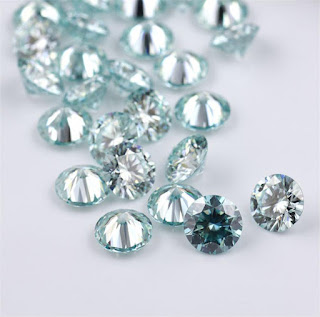
Moissanite delivers more brilliance than diamond for a fraction of the price. Its refractive index of 2.65–2.69 and dispersion of 0.104 produce intense rainbow flashes, especially in brilliant cuts. For fashion jewelry lines that need high visual impact at accessible price points, moissanite is the leading contender.
Key Features
- Brilliance: Total internal reflection is stronger than diamond because of higher refractive index. In round or radiant cuts, moissanite appears “whiter” and more lively under direct light.
- Durability: Mohs 9.25 is harder than any other diamond simulant. It resists scratching, chipping, and abrasion from normal wear.
- Custom shapes: Round, oval, pear, cushion, princess, emerald cut, asscher, heart, marquise, radiant, trapezoid, baguette, and special cuts are all available. The material can be precision-cut in faceted or crushed-ice styles.
- Cost advantage: A 1-carat equivalent moissanite costs $75–$400, versus $1,500–$10,000 for a similarly sized natural white diamond.
Who It's Best For
Designers producing mid-range fashion jewelry, stackable rings, earring sets, and bridal side-stone accents. Also ideal for large „statement“ stones in cocktail rings where budget constraints rule out diamond.
Limitations
- Moissanite has distinct “double refraction” — a slight doubling of facet edges visible under 10x loupe, which some purists dislike.
- Larger stones can appear slightly “oily” or “plastic” in certain flat lighting.
- Not a diamond, so cannot be marketed as one.
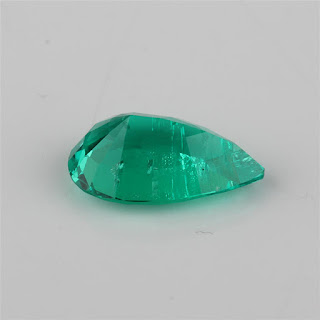
#3 Hydrothermal Emerald — Rich Color and No Inclusions
Hydrothermal emerald is grown in autoclaves under conditions that duplicate natural emerald formation — 700–800°C and 2,000 bars of pressure. The result is a crystal with identical chemical composition (beryllium aluminum silicate, colored by chromium and vanadium) but with substantially fewer inclusions. For bridal collections featuring colored center stones, hydrothermal emerald delivers vivid green without the brittleness of natural emerald.
Key Features
- Color consistency: Natural emerald exhibits strong color zoning. Hydrothermal stones can be grown in uniform “Colombian green” or “Zambian green” tones, batch after batch.
- Clarity: VVS clarity is standard, whereas natural VVS emerald costs a premium. Inclusions, if present, are tiny healed fractures rather than the three-phase inclusions common in natural stones.
- Specific gravity: 2.65–2.70, matching natural emerald exactly. Gemologists distinguish them only by advanced spectroscopy.
- Shape flexibility: Available in round, oval, pear, cushion, emerald cut, asscher, heart, and many more. Synonymous with classic emerald cuts.
Who It's Best For
Designers creating vintage-inspired bridal, Art Deco rings, or three-stone “trilogy” settings where the center stone must be a rich green. Also excellent for coordinated earring and pendant sets.
Limitations
- Mohs 7.5–8 is softer than moissanite or diamond, so it requires protective settings (bezel, halo) for daily wear.
- Hydrothermal stones can be susceptible to thermal shock if subjected to high heat during repair work.
#4 Synthetic Spinel — Versatile and Economical
Synthetic spinel is often overlooked, yet it offers surprisingly good optical properties at extremely low cost. With a Mohs hardness of 8 and refractive index of 1.72, synthetic spinel takes a good polish and delivers clean pastel colors — blue, pink, lavender, and colorless, plus vibrant red and green via dopants.
Key Features
- Low cost: A good-quality 1-carat synthetic spinel costs $10–$40. This makes it the most cost-effective way to color-match large runs of sidestones.
- Color stability: Unlike natural spinel, which can vary between batches, synthetic spinel offers excellent color reproducibility.
- Shape variety: Round melee, baguettes, trapezoids, marquise, and more are cut from boules that are consistent in size and quality.
Who It's Best For
Bridal and fashion designers who need accent stones — channel-set baguettes, melee halo rings, or pave bands — at minimal cost. Also good for fashion-forward statement pieces where large colored stones are required but budget is tight.
Limitations
- Mohs 8 is good but scratches more easily than sapphire or moissanite.
- Color range is more limited than the full spectrum of Other Color Lab Gemstones.
#5 Synthetic Sapphire & Ruby — Hardness Meets Color
Synthetic sapphire and ruby (both corundum, Al₂O₃, Mohs 9) are the hardest colored synthetic stones after diamond and moissanite. They are ideal for bridal rings because they handle daily wear — banging against counters, hand washing, accidental impacts — without chipping or fading. Relevant specifications and application guidance are available through Synthetic Sapphire & Ruby.
Key Features
- Hardness: Mohs 9 is second only to diamond. Synthetic corundum resists surface scratching extremely well.
- Vibrant colors: Blue sapphire, pink sapphire, padparadscha, and ruby are standard. Colors are consistent and reproducible.
- Clarity: Synthetic boules are generally inclusion-free, providing transparent stones with strong fire.
- Custom shapes: Round, oval, cushion, emerald cut, princess, and more. Available as melee for halo settings or large solitaires.
Who It's Best For
Bridal center stones in colored engagement rings, eternity bands with sapphire or ruby accents, and fashion jewelry lines that demand color and durability at middle-tier price points.
Limitations
- Synthetic corundum lacks the small inclusions (e.g., silk in natural sapphire) that can give natural stones a “velvety” appearance.
- Color options are limited to the corundum palette — greens and yellows are not as vibrant as hydrothermal emerald or synthetic spinel.
How to Choose the Right Synthetic Stone for Your Design
| If you need... | Choose... | Because... |
|---|---|---|
| A colorless center stone for an engagement ring | Lab-grown diamond | Hardest, most prestigious, indistinguishable from natural diamond |
| Maximum sparkle in a fashion ring | Moissanite | Higher refractive index than diamond, lower cost |
| A vivid green emerald cut for a vintage three-stone ring | Hydrothermal emerald | Color consistency, VVS clarity, identical to natural emerald chemistry |
| Affordable accent stones for a pavé or channel band | Synthetic Stone (spinel or cubic zirconia) | Lowest cost per carat, easy to color-match large volumes |
| A deep blue or red center stone for a daily-wear ring | Synthetic sapphire or ruby | Mohs 9 hardness, resists chipping, excellent color saturation |
Frequently Asked Questions
What is the best synthetic stone for a bridal engagement ring?
Lab-grown diamond is the best synthetic stone for engagement rings because it is identical to natural diamond in hardness (Mohs 10), brilliance (refractive index 2.417), and overall quality grading per GIA and IGI standards. It provides the same sparkle and durability as a mined diamond but at a 40–60% lower retail price.
Are synthetic stones durable enough for everyday wear?
Yes. Lab diamond (Mohs 10), moissanite (9.25), synthetic sapphire and ruby (9) all exceed the hardness needed for daily wear. Hydrothermal emerald (7.5–8) and synthetic spinel (8) are also fine for rings if set protectively, but you should avoid soft stones like cubic zirconia (8.5 but brittle) for rings worn daily.
Do synthetic stones pass gemological tests?
Lab-grown diamonds pass standard thermal and electrical conductivity tests because they are chemically identical to natural diamond. They can be distinguished from natural stones only by advanced spectroscopy or microscopy (for specific crystal growth patterns). Moissanite has double refraction, which any gemologist can detect with a loupe — so it is easily identified and should never be sold as diamond.
Final Thoughts
The best synthetic stone options for fashion jewelry and bridal designs depend on your application — budget, color requirements, daily-wear demands, and production volume. For high-end bridal, lab-grown diamond remains the gold standard. For maximum brilliance at an accessible price, moissanite leads the market. For colored gemstone designs, hydrothermal emerald, synthetic sapphire and ruby, and synthetic spinel offer reliable color, excellent clarity, and consistent supply.
By choosing synthetic stones from a manufacturer like Starsgem, designers and brands gain access to round melee from 0.003 carats, precision-cut fancy shapes, and delivery times of 2–4 business days via DHL or FedEx — allowing faster production cycles and reduced raw-material risk. Whether you need a 1-carat lab diamond solitaire or a pavé band of 2,000 melee stones, synthetic options deliver measurable, documented performance at scale.

评论
发表评论